In 2023, the island’s average residential property value reached €6,083.2 per square metre, up 14.68% from the previous year. For owners, developers and investors, that level of valuation makes one thing increasingly important: protecting the long-term quality, efficiency and desirability of the asset itself.
At the same time, Europe is changing the rules governing how buildings are designed, constructed, renovated and operated.
The revised EU Energy Performance of Buildings Directive (EPBD) is moving the European building sector beyond the traditional idea of simply reducing energy consumption. The direction of travel is now much broader: highly efficient buildings, renewable energy, elimination of on-site fossil-fuel emissions and, increasingly, measurement of the carbon impact of a building across its entire life cycle.
For Ibiza's premium property market, this represents more than a regulatory challenge.
It represents an opportunity.
The properties that will stand out over the next decade will not only be architecturally exceptional. They will also be energy intelligent, increasingly independent from fossil fuels, lower in operational cost and designed for the environmental standards of the future.
At Ibiza SunPower, we believe this is where luxury and sustainability converge.
2027 Is a Turning Point — Not a Deadline for Every Villa
There is a common misconception that European regulations will suddenly require every existing private villa to become zero-emission in 2027.
That is not what the legislation says.
Instead, 2027 is an important milestone in a broader transition.
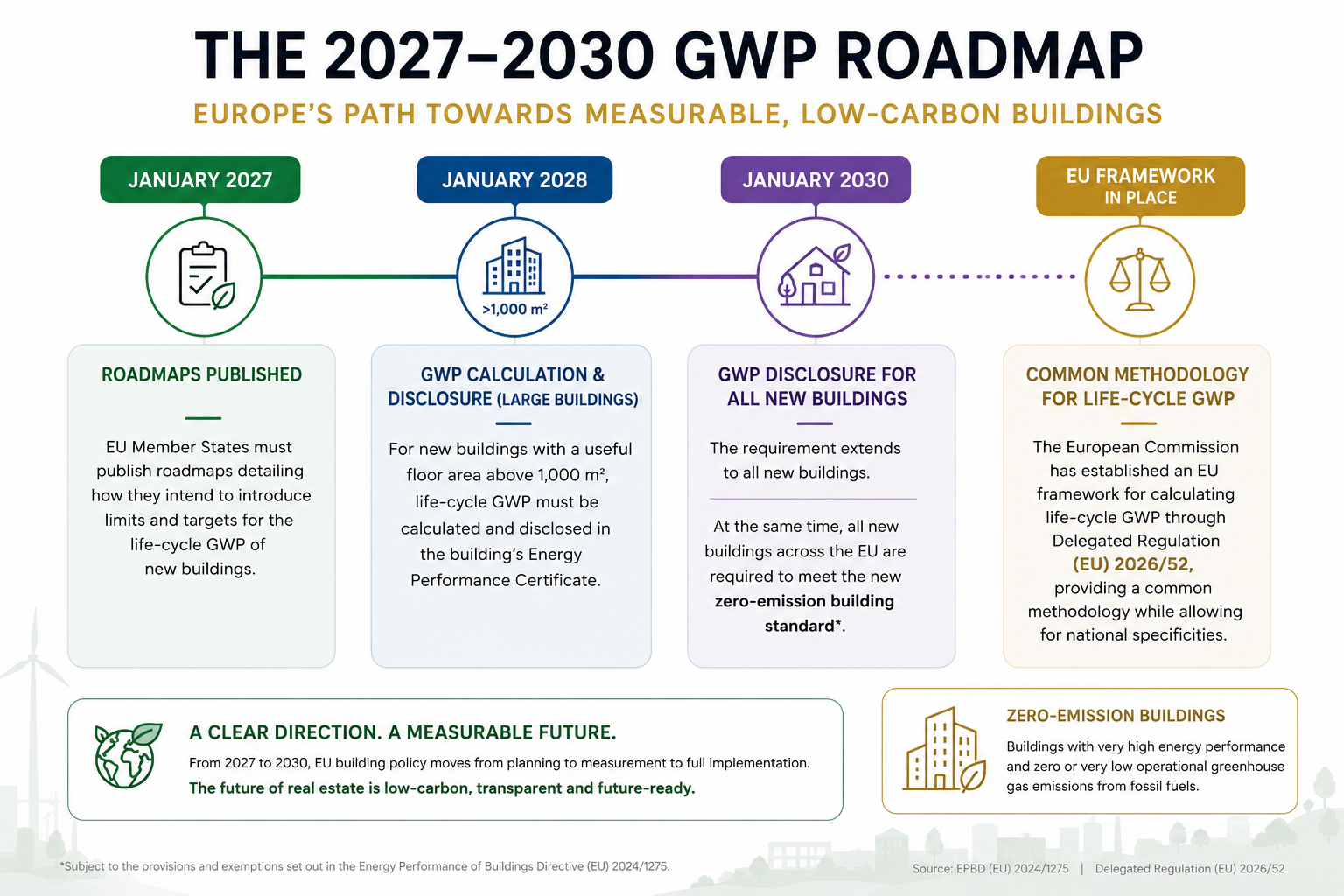
Under the revised EPBD, EU Member States must publish, by 1 January 2027, roadmaps setting out how they intend to introduce limits on the total life-cycle Global Warming Potential (GWP) of new buildings, together with targets for new buildings from 2030.
At the same time, the EU's new ETS2 carbon market is being introduced for emissions from fuel combustion in buildings, road transport and other covered sectors.
The current EU framework provides for ETS2 to become fully operational in 2028, following a transition period in which allowances are auctioned from 2027. The system regulates fuel suppliers rather than individual homeowners, but the European Commission explicitly recognises that carbon costs can flow downstream to consumers.
For property owners, the message is therefore simple:
The cost and strategic risk of continuing to depend on fossil-fuel heating will increasingly become harder to ignore.
1. The End of Fossil-Fuel Dependence
For decades, the energy system of a luxury property was relatively straightforward:
Electricity for lighting and appliances.
Oil or gas for heating.
Perhaps a diesel generator for backup.
That model is rapidly becoming outdated.
Europe's building policy is increasingly designed around highly efficient buildings powered by clean energy. The EPBD defines a zero-emission building as one with very high energy performance, no on-site carbon emissions from fossil fuels and zero or very low operational greenhouse-gas emissions.
This has significant implications for premium properties.
A modern luxury villa can consume substantial amounts of energy through:
- Air conditioning
- Heating
- Domestic hot water
- Swimming pools and pool heating
- Wellness and spa facilities
- EV charging
- Lighting and automation
- Kitchens and appliances
- Water treatment
- Security systems
- Home offices and entertainment systems
The answer is not simply to generate more electricity.
The real opportunity is to design the entire energy ecosystem as one integrated system.
That means combining photovoltaic generation, battery storage, intelligent energy management, high-efficiency HVAC, heat pumps, EV charging and building automation.
The result is a property that can produce, store and intelligently manage a much greater proportion of its own energy.
2. ETS2: Why Fossil-Fuel Heating Is Becoming a Strategic Risk
The EU's ETS2 is one of the most significant changes affecting the economics of fossil-fuel heating.
Unlike the existing EU ETS, ETS2 covers fuel combustion associated with buildings, road transport and additional sectors. Importantly, the system operates upstream: fuel suppliers are the regulated entities rather than homeowners themselves.
But that does not mean property owners are unaffected.
Carbon costs can be reflected in the price of fossil fuels, creating an additional economic incentive to move away from oil, gas and other carbon-intensive heating systems.
For a premium property, this creates a straightforward investment question:
Why continue investing in a heating system whose underlying fuel is becoming progressively more exposed to carbon pricing?
Modern heat-pump technology offers an alternative.
When combined with appropriately sized photovoltaic generation and battery storage, electricity can replace fossil fuels for heating and cooling while allowing the property to make far better use of its renewable energy production.
In Ibiza, where solar irradiation is exceptionally strong, this becomes particularly compelling.
The objective is not simply to reduce an energy bill.
It is to change the energy architecture of the property.
3. From Energy Performance to Whole-Life Carbon
Perhaps the most important change for architects and developers is the EU's growing focus on life-cycle Global Warming Potential.
Traditional energy certification primarily asks:
How efficiently does this building operate?
The new approach asks a much bigger question:
What is the total climate impact of this building across its life cycle?
The EPBD defines whole-life-cycle greenhouse-gas emissions to include emissions associated with construction products, transportation, construction activities, energy used during operation, replacement of products, demolition, waste management, reuse and recycling.
This is a fundamental shift.
A building can no longer be considered sustainable simply because it has efficient air conditioning and solar panels.
The materials, construction methods, energy systems and eventual end-of-life of the building increasingly become part of the sustainability equation.
For developers and architects, this means that decisions made during the earliest stages of a project can have consequences for the property's environmental performance decades later.
source:
EPBD (EU) 2024/1275
4. The 2027–2030 GWP Roadmap
The timeline is already clear.
January 2027
EU Member States must publish roadmaps detailing how they intend to introduce limits and targets for the life-cycle GWP of new buildings.
January 2028
For new buildings with a useful floor area above 1,000 m², life-cycle GWP must be calculated and disclosed in the building's Energy Performance Certificate.
January 2030
The requirement extends to all new buildings.
At the same time, all new buildings across the EU are required to meet the new zero-emission building standard, subject to the provisions and exemptions of the Directive.
The European Commission has already established an EU framework for calculating life-cycle GWP through Delegated Regulation (EU) 2026/52, providing a common methodology while allowing for national specificities.
This means the direction of travel is no longer theoretical.
It is becoming measurable.
5. What This Means for Ibiza's Luxury Property Market
For the average property, energy efficiency is primarily an operating-cost issue.
For a €5 million, €10 million or €20 million property, the equation is different.
Energy infrastructure becomes part of the asset.
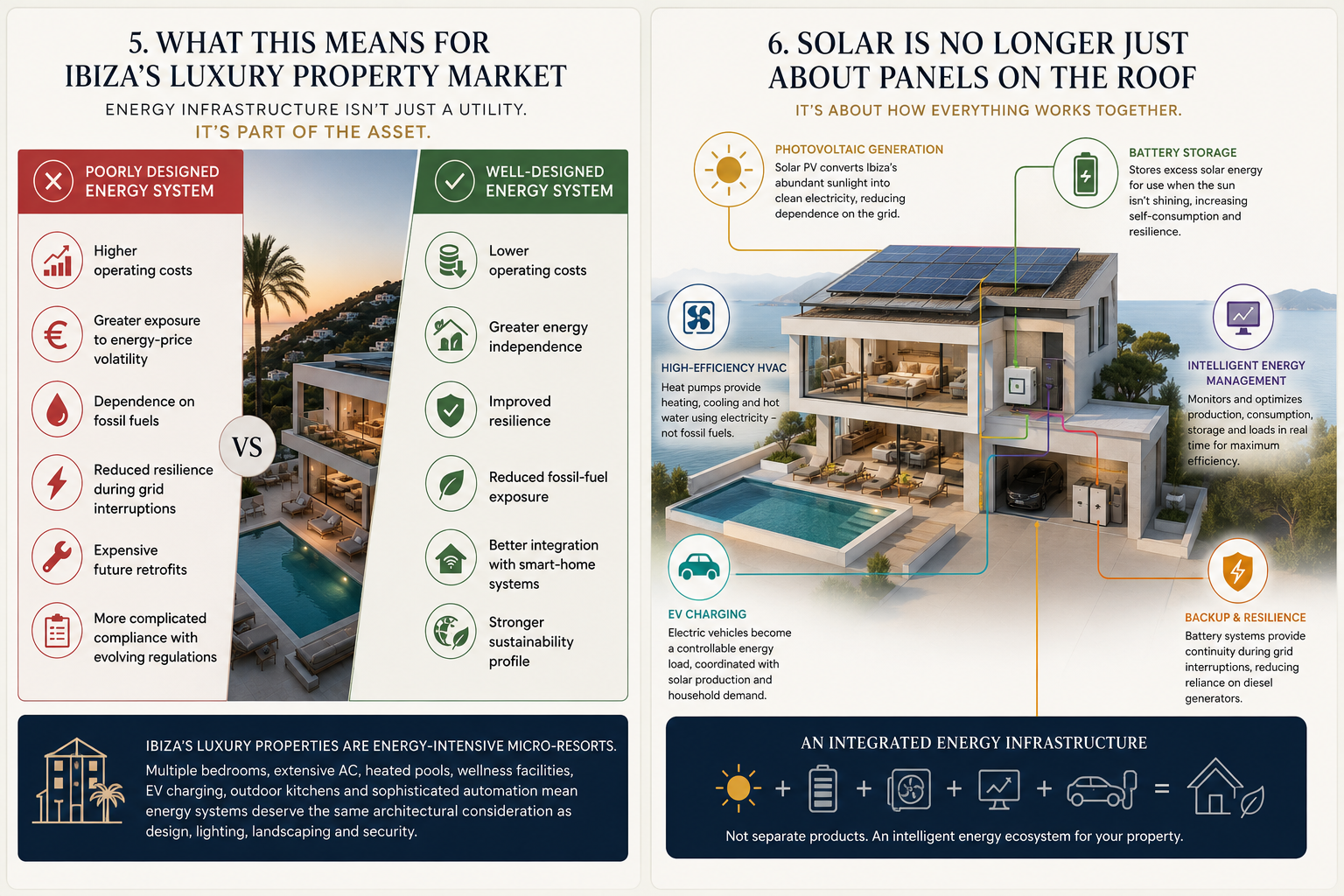
A poorly designed energy system can mean:
- Higher operating costs
- Greater exposure to energy-price volatility
- Dependence on fossil fuels
- Reduced resilience during grid interruptions
- Expensive future retrofits
- More complicated compliance with evolving regulations
A well-designed energy system can provide the opposite.
It can deliver:
Lower operating costs.
Greater energy independence.
Improved resilience.
Reduced fossil-fuel exposure.
Better integration with smart-home systems.
A stronger sustainability profile.
And increasingly, a more future-ready asset.
This is particularly relevant in Ibiza, where many luxury properties are effectively energy-intensive micro-resorts.
A villa with multiple bedrooms, extensive air conditioning, heated pools, outdoor kitchens, wellness facilities, EV charging and sophisticated automation can have an energy profile closer to a small hospitality operation than a conventional home.
The energy system therefore deserves the same level of architectural consideration as the lighting, interiors, landscaping and security.
6. Solar Is No Longer Just About Panels on the Roof
The next generation of premium solar installations will not be defined by the number of panels installed.
They will be defined by how intelligently the entire system works together.
A modern energy ecosystem can combine:
Photovoltaic generation
Solar PV converts Ibiza's abundant sunlight into clean electricity, reducing dependence on the grid.
Battery storage
Energy storage allows excess solar generation to be retained and used when the sun is no longer producing, increasing self-consumption and providing additional resilience.
High-efficiency HVAC
Modern heat pumps can provide heating, cooling and hot water using electricity rather than fossil fuels, dramatically improving the efficiency of the building's thermal systems.
Intelligent energy management
Energy management systems can monitor production, consumption, storage and loads in real time, deciding when energy should be generated, stored or consumed.
EV charging
Electric vehicles can become another controllable energy load, allowing charging to be coordinated with solar production and household demand.
Backup and resilience
Battery systems can provide continuity during grid interruptions, reducing the dependence on diesel generators and other fossil-fuel backup systems.
The result is not a collection of separate products.
It is an integrated energy infrastructure for the property.

7. The New Definition of Luxury
Luxury has always been about more than appearance.
It is about comfort, convenience, reliability, privacy and control.
The next generation of luxury properties will add another dimension:
energy independence.
Imagine a villa that automatically produces electricity from the sun, stores excess energy, intelligently manages HVAC and pool systems, charges electric vehicles when energy is most economical, and maintains critical systems during a grid interruption.
The owner does not need to think about any of it.
The technology simply works.
That is the difference between installing solar panels and designing an energy ecosystem.
8. Designing for the Next Decade — Not the Last One
One of the most expensive mistakes in real estate is designing today's building around today's requirements.
A premium property can remain in the market for decades.
The regulatory environment will change many times during that period.
Energy prices will change.
Technology will change.
Grid requirements will change.
Buyer expectations will change.
The most intelligent approach is therefore to design infrastructure with the future in mind.
For a new development, that means considering energy generation, storage, HVAC, building envelope performance, materials, EV infrastructure and smart controls from the earliest design stages.
For an existing villa, it means assessing where energy is actually being consumed and developing a phased roadmap for electrification and energy independence.
The objective is not necessarily to replace everything at once.
It is to avoid making investments today that create expensive constraints tomorrow.
The Ibiza SunPower Approach
At Ibiza SunPower, we believe the future of premium energy is not about selling individual components.
It is about designing complete energy ecosystems around the property.
Our approach brings together photovoltaic generation, battery storage, intelligent energy management, high-efficiency HVAC, EV charging and electrical infrastructure into a single engineered system.
Every property is different.
A newly constructed architectural villa requires a different strategy from a 20-year-old estate with high cooling loads, a heated pool and an existing diesel generator.
That is why we start with the property itself.
We analyse energy consumption, generation potential, HVAC requirements, storage requirements, grid infrastructure and future loads before designing the system.
The result is a solution built around the way the property actually operates.
The Premium Property of the Future
The European energy transition is not simply changing how buildings consume energy.
It is changing what we should expect from buildings.
The luxury property of the future will not be defined solely by its architecture, location or interior design.
It will also be:
Efficient.
- Intelligent.
- Resilient.
- Low-carbon.
- Energy independent.
And designed to remain relevant as European building standards continue to evolve.
For Ibiza's property owners, developers and architects, the question is therefore no longer:
“Do I need solar?”
The more important question is:
“Is my property prepared for the energy and regulatory environment of the next decade?”
The transition has already started.
2027 is an important milestone.
2030 is an even bigger one.
The properties that prepare early will have an advantage—not only in compliance, but in operating costs, resilience, sustainability and long-term positioning.
At Ibiza SunPower, we believe the future of luxury is powered by the sun.
300 days of sun. Make the most out of it.
A note for owners, architects and developers
If you are planning a new villa, major renovation or commercial development in Ibiza, the energy strategy should be considered before the final architectural and MEP decisions are made.
The earlier energy generation, storage, HVAC and building performance are integrated into the design, the more opportunities there are to optimise the system—and avoid expensive retrofits later.
Ibiza SunPower can help you develop an energy strategy designed around the property, its architecture and its long-term objectives.